# Google Maps - Maximising network effects with generative AI

> How Google Maps maximises network effects as a platform ecosystem, and how generative AI will amplify them. A product strategy analysis with 1B+ monthly users.

- Canonical: https://hcd.ai/product-strategy/google-maps-network-effects-generative-ai/
- Published: 2023-10-14
- Author: Sasha Merzliakov (https://hcd.ai/about/)
- Pillar: Product Strategy

---


<p>Google Maps is the most popular navigation app in the world with over 1 billion monthly users (Pawar, 2023). As a <strong>digital platform ecosystem</strong> it includes features beyond its core mapping capability to maximise network effects and with the advent of generative AI is expected to maximise network effects further. For a broader look at how GenAI transforms the <a href="/product-strategy/generative-ai-digital-business-innovation/">digital business innovation process</a>, see the companion analysis.</p>


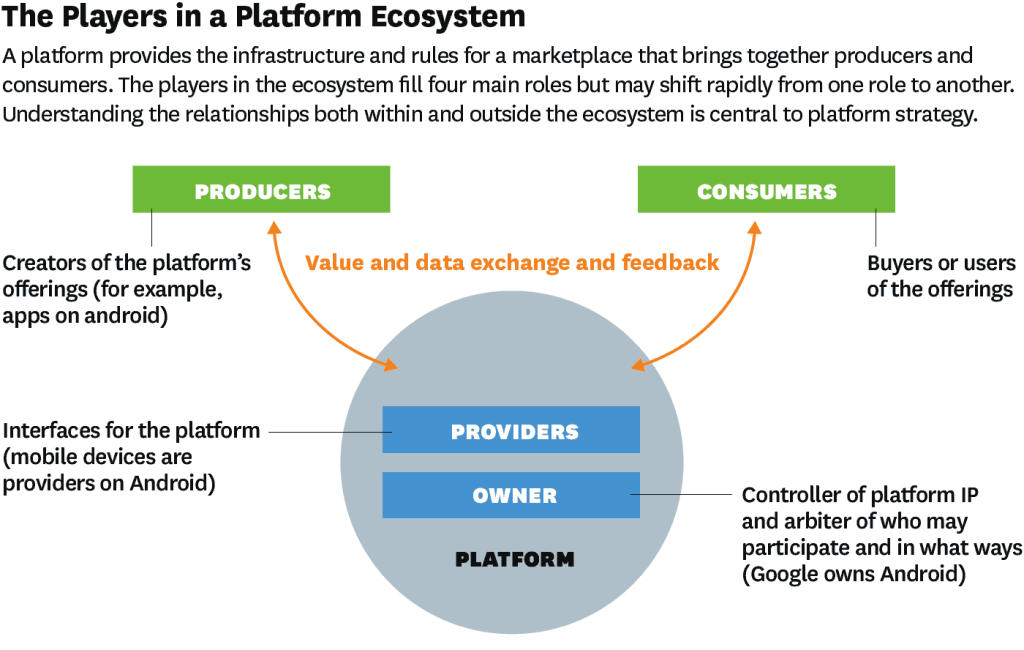
<p>The players in a digital platform ecosystem include producers and consumers as visualised in Figure 1 (Alstyne, Parker &amp; Choudary, 2016). With its core mapping capability, platform users are <strong>concurrently producers <em>and</em> consumers</strong>—AI uses the collective location data shared whilst at the same time predicting travel times and mapping the best route (Lau, 2020; Levine &amp; Jain, 2023). Google Maps also<strong> brings together producers and consumers</strong> through retail features such as its store and product locator, and individual features such as local information (Google, n.d.).</p>


<p></p>


<figure class="wp-block-image size-large"><img src="/assets/images/posts/Platform-Ecosystem-1024x650.png" alt="The Players in a Platform Ecosystem" class="wp-image-4390"/></figure>


<p>Figure 1: The Players In A Platform Ecosystem (Alstyne, Parker &amp; Choudary, 2016)</p>


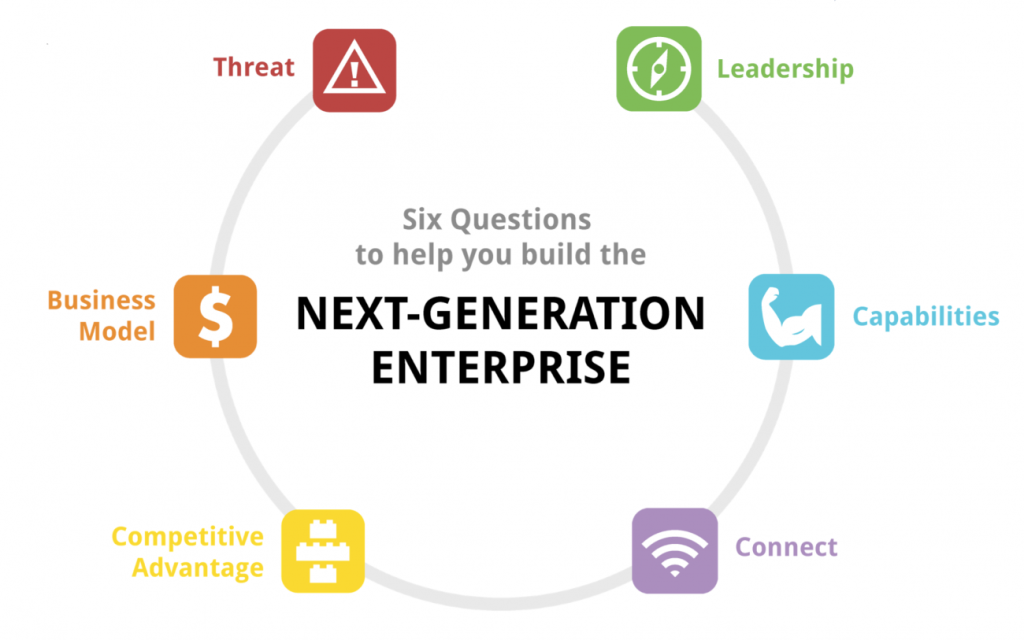
<p>Google Maps is defined as "Tech Performance Network Effects" according to NFX (2021), that is "its performance directly improves with increased numbers of users". In addition to understanding this <strong>"Digital Competitive Advantage"</strong>, it is assumed by its ongoing innovation in the space of generative AI (Liu, 2023) that Google has also asked <strong>"What is the Digital Threat and Opportunity?"</strong> (Weill &amp; Woerner, 2018).</p>


<p></p>


<figure class="wp-block-image size-large"><img src="/assets/images/posts/Next-Generation-Enterprise-1024x640.png" alt="Six Questions to help you build the Next-Generation Enterprise" class="wp-image-4391"/></figure>


<p>Figure 2: Six Questions to help you build the Next-Generation Enterprise (Weill &amp; Woerner, 2018)</p>


<p>Google's Partner Innovation is "developing a series of Generative AI templates" to showcase possibilities of using Generative AI with their APIs, in particular for travel (Liu, 2023), providing ecosystem producers inspiration and know-how to quickly innovate. Wang (2023) from the Lufthansa Innovation Hub sees Google Maps "as the foundation of a transformative AI-powered travel experience", leveraging generative AI to "create a more efficient, personalised, and engaging travel booking experience".</p>


<p>Given the transformative impact of generative AI it is both a digital threat and opportunity. Ecosystem players and platforms such as Google Maps are exploring strategies to maximise their network effects, but undoubtedly aware of the threat it also presents.</p>


<p></p>


<hr class="wp-block-separator has-alpha-channel-opacity"/>


<p>This post is a part of a series from my MBA (Technology) studies through the <a href="https://www.unsw.edu.au/business/our-schools/agsm" target="_blank" rel="noreferrer noopener">Australian Graduate School of Management @ UNSW Business School</a></p>

<aside class="not-prose mt-16 pt-8 border-t border-brand-border">
<p class="section-label mb-4">References</p>
<div class="text-sm text-brand-text-muted space-y-2">
<p>FOX, L. 2023. <em>Could Generative AI Make Google Maps a Full Travel App?</em> [Online]. PhocusWire. Available: <a href="https://www.phocuswire.com/google-maps-generative-ai-search-inspiration" target="_blank" rel="noreferrer noopener" class="text-brand-accent hover:text-brand-accent-hover transition-colors">phocuswire.com</a> [Accessed 11/10/2023].</p>
<p>GOOGLE. n.d. <em>Welcome to Google Maps Platform</em> [Online]. Google. Available: <a href="https://mapsplatform.google.com/" target="_blank" rel="noreferrer noopener" class="text-brand-accent hover:text-brand-accent-hover transition-colors">mapsplatform.google.com</a> [Accessed 10/10/2023].</p>
<p>LAU, J. 2020. <em>Google Maps 101: How AI helps predict traffic and determine routes</em> [Online]. Google. Available: <a href="https://blog.google/products/maps/google-maps-101-how-ai-helps-predict-traffic-and-determine-routes/" target="_blank" rel="noreferrer noopener" class="text-brand-accent hover:text-brand-accent-hover transition-colors">blog.google</a> [Accessed 10/10/2023].</p>
<p>LEVINE, S. S. &amp; JAIN, D. 2023. <em>How Network Effects Make AI Smarter</em> [Online]. Harvard Business Review Digital Articles, pp. 1–6. [Accessed 10/10/2023].</p>
<p>LIU, Y. 2023. <em>Using Generative AI for Travel Inspiration and Discovery</em> [Online]. Google. Available: <a href="https://developers.googleblog.com/2023/05/generative-ai-travel-developers.html" target="_blank" rel="noreferrer noopener" class="text-brand-accent hover:text-brand-accent-hover transition-colors">developers.googleblog.com</a> [Accessed 10/10/2023].</p>
<p>MERZLIAKOV, S. 2023. [Feature image generated using Midjourney]</p>
<p>MIT SLOAN CIO SYMPOSIUM VIDEOS. 2018. <em>What's your digital business model?</em> [Online]. Available: <a href="https://www.youtube.com/watch?v=W0b-a6RIwLY" target="_blank" rel="noreferrer noopener" class="text-brand-accent hover:text-brand-accent-hover transition-colors">youtube.com</a> [Accessed 10/10/2023].</p>
<p>NFX. 2021. <em>The Network Effects Manual: 16 Network Effects (And Counting)</em> [Online]. NFX. Available: <a href="https://www.nfx.com/post/network-effects-manual#Tech-Performance-Network-Effects" target="_blank" rel="noreferrer noopener" class="text-brand-accent hover:text-brand-accent-hover transition-colors">nfx.com</a> [Accessed 29/09/2023].</p>
<p>PAWAR, S. 2023. <em>Google Maps Statistics</em> [Online]. EnterpriseAppsToday. Available: <a href="https://www.enterpriseappstoday.com/stats/google-maps-statistics.html" target="_blank" rel="noreferrer noopener" class="text-brand-accent hover:text-brand-accent-hover transition-colors">enterpriseappstoday.com</a> [Accessed 10/10/2023].</p>
<p>SINGH, S. 2023. <em>Generative AI: Platforms, Network Effects, and the Economics of Abundance</em> [Online]. Speedinvest. Available: <a href="https://www.speedinvest.com/blog/generative-ai-platforms-network-effects-and-the-economics-of-abundance" target="_blank" rel="noreferrer noopener" class="text-brand-accent hover:text-brand-accent-hover transition-colors">speedinvest.com</a> [Accessed 10/10/2023].</p>
<p>VAN ALSTYNE, M. W., PARKER, G. G. &amp; CHOUDARY, S. P. 2016. <em>Pipelines, platforms, and the new rules of strategy</em>. Harvard Business Review, vol. 94, no. 4, pp. 54–62.</p>
<p>WANG, C. 2023. <em>Future Travel: All Great Journeys Start With A Map</em> [Online]. TNMT. Available: <a href="https://tnmt.com/reports/all-great-journeys-start-with-a-map/" target="_blank" rel="noreferrer noopener" class="text-brand-accent hover:text-brand-accent-hover transition-colors">tnmt.com</a> [Accessed 11/10/2023].</p>
<p>WEILL, P. &amp; WOERNER, S. L. 2018. <em>Six Questions To Help You Build The Next-Generation Enterprise</em> [Online]. MIT CISR. Available: <a href="https://cisr.mit.edu/publication/2018_0501_SixQuestions_WeillWoerner" target="_blank" rel="noreferrer noopener" class="text-brand-accent hover:text-brand-accent-hover transition-colors">cisr.mit.edu</a> [Accessed 10/10/2023].</p>
</div>
</aside>