
Generative AI in the Digital Business Innovation Process
What impact will Artificial Intelligence have in the Digital business innovation process when we consider the success businesses have had without AI and the impact they've already made on the world. For enterprise adoption data on how companies are using GenAI today, see Generative AI in the Enterprise.
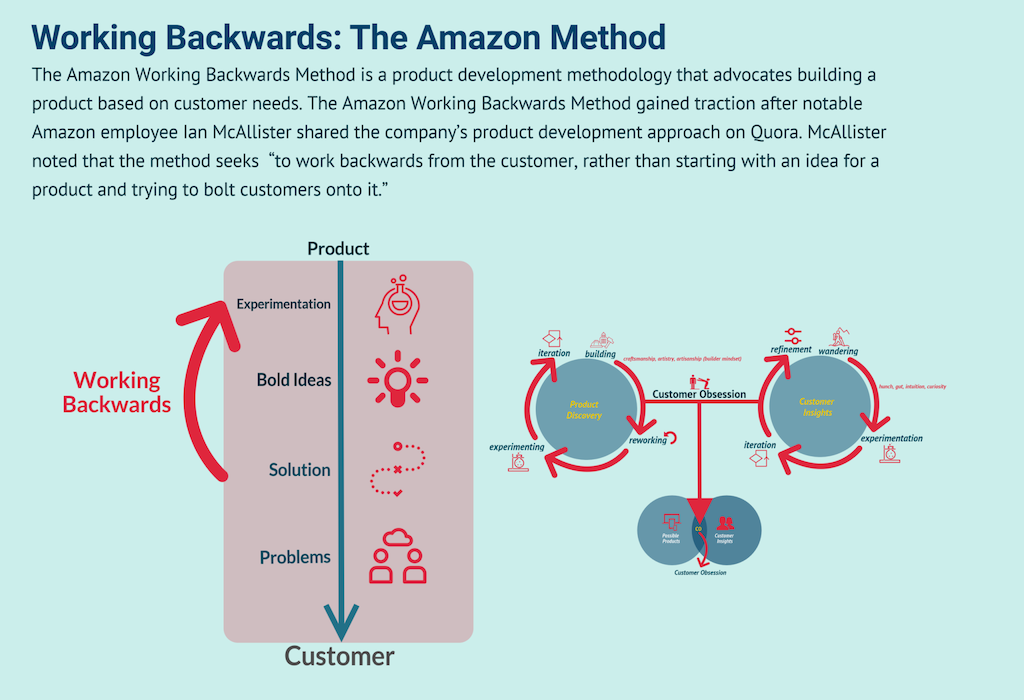
Amazon’s secret to innovation (Kaplan, 2021) is due to an innovation process shared by former executives Colin Bryar and Bill Carr known as ‘working backwards’.
Source: Cuofano (2023)
This digital business innovation process involves (i) Defining the customer problem, (ii) Defining the ideal product solution, (iii) Working backwards from the ideal customer experience, then (iv) Refining and repeating previous steps.
This process has led to innovations at Amazon that include Amazon Prime, Kindle and Echo to name just a few (Malik, 2017).
The innovation funnel at John Lewis Partnership (Peppard & Ward, 2016), in contrast, is a linear process, originally used by the IT organisation “as a way to report and keep track of the dozens of new information technologies”. This shows in its resemblance to a product backlog (Radigan, n.d) and a series of stage gates the idea has to pass through before it is realised, i.e., (i) Identify, (ii) Candidate, (iii) Propose, (iv) Develop, (v) Trial & (vi) Deliver (Peppard & Ward, 2016).
Evaluating each process, Amazon’s is a standout in that it has an absolute focus on the customer (the whole process is engineered around the customer), and employs an iterative approach to land on and refine the solution.
One of the key components of Amazon’s process in ‘defining the ideal product solution’ is 'ideation', a common activity in the Design Thinking process and used across other companies such as GE Healthcare, Netflix, Airbnb and UberEats (Han, 2022).
Enter ChatGPT and the new world of generative AI, where “Artificial Intelligence (AI), specifically GPT-4, was found to match the top 1% of human thinkers on a standard creativity test” (Shimek, 2023), and poised to take the ideation process and its outputs to a whole new level. Researchers such as Heidrich et al. (2023) in their paper titled "Building AI Innovation Labs together with Companies" demonstrate a comprehensive framework utilising AI to support ideation, implementation and evaluation of innovations.
The full impact of generative AI and Large Language Models (LLMs) on innovation is yet to be fully realised however early signs show it will play an important role and given "success in business is about obtaining a competitive advantage, and innovation is the key to achieving it" (Lesser, 2022), a role worth including and exploring today.
This post is a part of a series from my MBA (Technology) studies through the Australian Graduate School of Management @ UNSW Business School