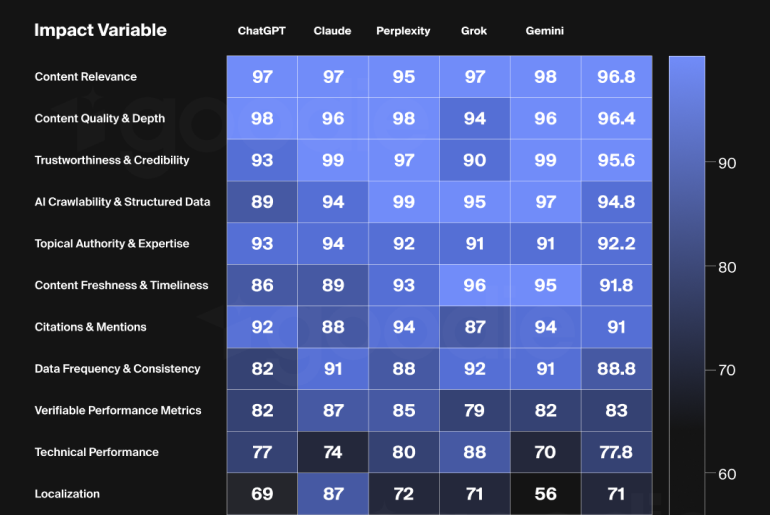
What's driving AI search visibility
Fifteen factors drive whether AI search tools like ChatGPT, Perplexity, and Claude cite your content: they include structured data, direct-answer formatting, topical authority, recency signals, and source reputation, among others. I've analysed what the current AI models actually prioritise when selecting sources to reference in their responses.
As AI search tools like ChatGPT, Claude, and Perplexity reshape how users discover information, traditional SEO is rapidly losing relevance. Answer Engine Optimisation (AEO) is the new frontier, and understanding what drives AI visibility is crucial for organic growth.
The Research
Goodie's 3-month study analysed over 1 million prompts across five major AI models, identifying 15 key factors that influence AI search rankings. These elements form the "AEO Periodic Table" - a scientific framework for optimising content in the AI era.
Key Findings
The research reveals dramatic differences between AI models:
- ChatGPT prioritises semantic depth and comprehensive content
- Claude maintains the strictest factual verification standards
- Grok heavily weights real-time social signals and freshness
- Perplexity shows exceptional sensitivity to structured data
- Gemini takes a trust-first approach, devaluing social signals
Critical Insights
Some industries see 30% of informational queries shifting to AI interfaces. Yet fewer than 5% of websites properly implement the technical requirements that dramatically increase AI visibility.
The study identified specific schema implementations, content freshness thresholds, and 'crawlability' factors that can double AI citation rates in controlled testing. Mastering prompt engineering techniques also helps understand how AI models process and surface content.
The Bottom Line
The transition from SEO to AEO isn't coming, it's here. Organisations that master these 15 scientifically-backed elements will establish sustainable competitive advantages as AI continues to mediate information discovery.
The full AEO Periodic Table report provides detailed implementation guidance across all factors and model-specific optimisation strategies.
Download the report
Download the full report from Goodie:
https://www.higoodie.com/blog/ai-search-visability-factors-aeo-periodic-table
Frequently Asked Questions
What is Answer Engine Optimisation (AEO)?
Answer Engine Optimisation (AEO) is the practice of optimising content to be cited and surfaced by AI search tools like ChatGPT, Claude, Perplexity, and Google AI Overviews. Unlike traditional SEO which targets search engine rankings, AEO focuses on making content extractable, authoritative, and structured so AI models select it as a source when answering user queries.
How is AEO different from traditional SEO?
Traditional SEO optimises for search engine ranking algorithms using keywords, backlinks, and technical factors. AEO optimises for AI citation by focusing on semantic depth, structured data, factual verification, and content freshness. Each AI model also weighs factors differently — ChatGPT prioritises comprehensive content, Claude values factual accuracy, and Perplexity is sensitive to structured data.
What are the key factors that influence AI search visibility?
Research analysing over 1 million prompts across five AI models identified 15 key factors including semantic depth, structured data implementation, content freshness, factual verification standards, and crawlability. Specific schema implementations and freshness thresholds can double AI citation rates. Fewer than 5% of websites currently implement these technical requirements properly.
How do different AI models rank content differently?
Each AI model has distinct priorities: ChatGPT prioritises semantic depth and comprehensive content, Claude maintains the strictest factual verification standards, Grok heavily weights real-time social signals and freshness, Perplexity shows exceptional sensitivity to structured data, and Gemini takes a trust-first approach that devalues social signals.
How much traffic is shifting to AI search?
Some industries already see 30% of informational queries shifting to AI interfaces. This transition from SEO to AEO is accelerating as users increasingly rely on ChatGPT, Claude, Perplexity, and other AI tools for information discovery rather than traditional search engines.