
Get Ready for the GenUI Web
For just over three decades brands designed the web page the customer saw. That era is closing. AI agents now sit between the brand and the customer, through third-party interfaces such as ChatGPT, and through first-party capability where agents assemble personalised experiences at runtime. The brand's job is moving from pre-defining experiences to guiding agents to orchestrate them: the stage is set with content, components, objectives, and rules, and the agent performs differently for every visitor. I built one over the hcd.ai content to find out what that takes. It runs at ask.hcd.ai. This article explores the GenUI website space and how to get started.
When customers stop visiting your website
For over thirty years, the process was clear. Brands designed the web page, optimised the funnel, ran a test, moved the button, rewrote the headline, and watched the conversion rate move. The website the customer experienced was the website they designed.
This no longer holds true. A growing number of customers never reach the page in the first place. They ask ChatGPT, Claude, or Perplexity, and an agent answers on the brand's behalf, composing a response from whatever it sourced and assembling it into something the brand never specifically defined. The page still exists, it's just that customers are increasingly interacting with agents and have no need to visit it.
This part is really worth thinking about. The whole apparatus of web design, the carefully written hierarchy, the mapped journey, the moment of delight placed three scrolls down, runs on the premise that a human lands on a surface the brand controls and moves through it the way the brand intended. An agent in the middle breaks that premise. It does not move through the brand's surface. It draws from the brand's content and builds its own.
So how does a brand wrestle back some control? I propose the following approach. First, the website has to deliver value that ChatGPT, Claude, and Perplexity don't. Second, as more people grow accustomed to interacting with agents, the website has to evolve to provide a similar experience, not send them back to what's effectively becoming the stone age. GenUI websites are one way to do both.
From designing experiences to guiding the orchestration of them
My view is that the brand's role needs to move from designing experiences to guiding agents to orchestrate them, and this role will become an increasing blend of functions beyond design.
GenUI websites are when an agent assembles the user experience at runtime. The thing the customer sees is no longer drawn by hand. The agent draws a different thing for every visitor. What can be designed is the system the agent draws from: the content it quotes, the components it is allowed to place, the objectives it is steering toward, and the rules it cannot break. The stage is set, the agent performs on it, and the performance is personalised for every visitor.
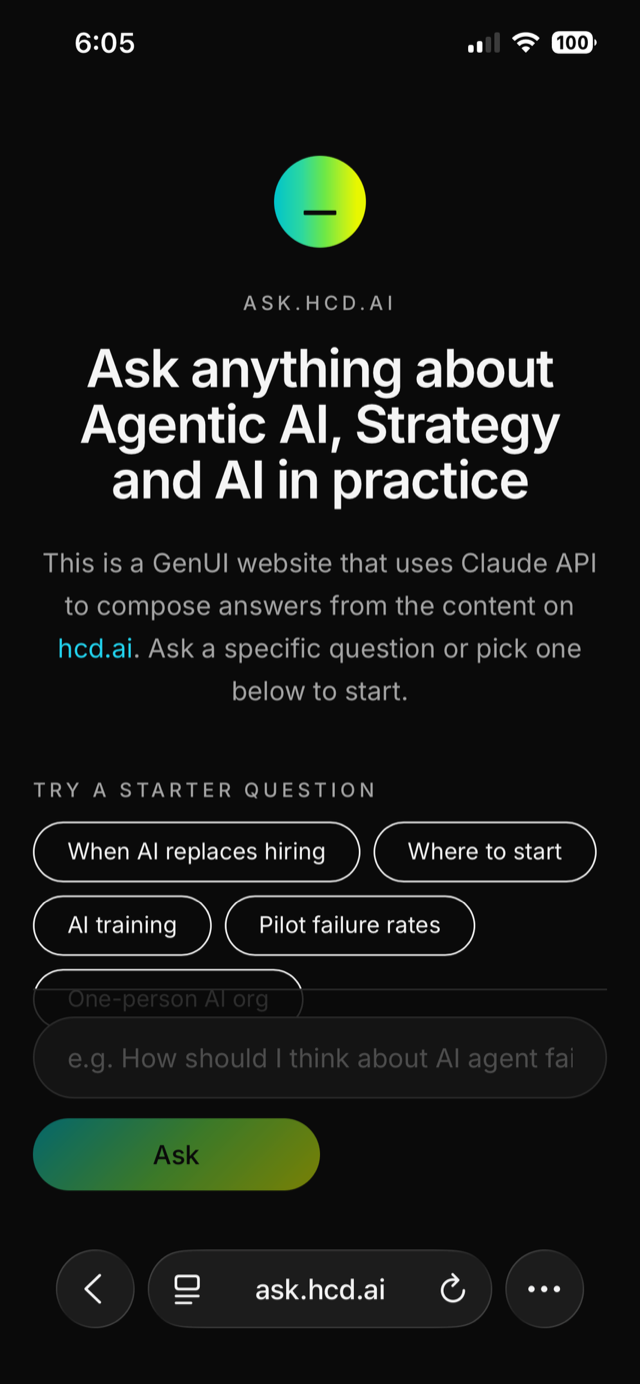

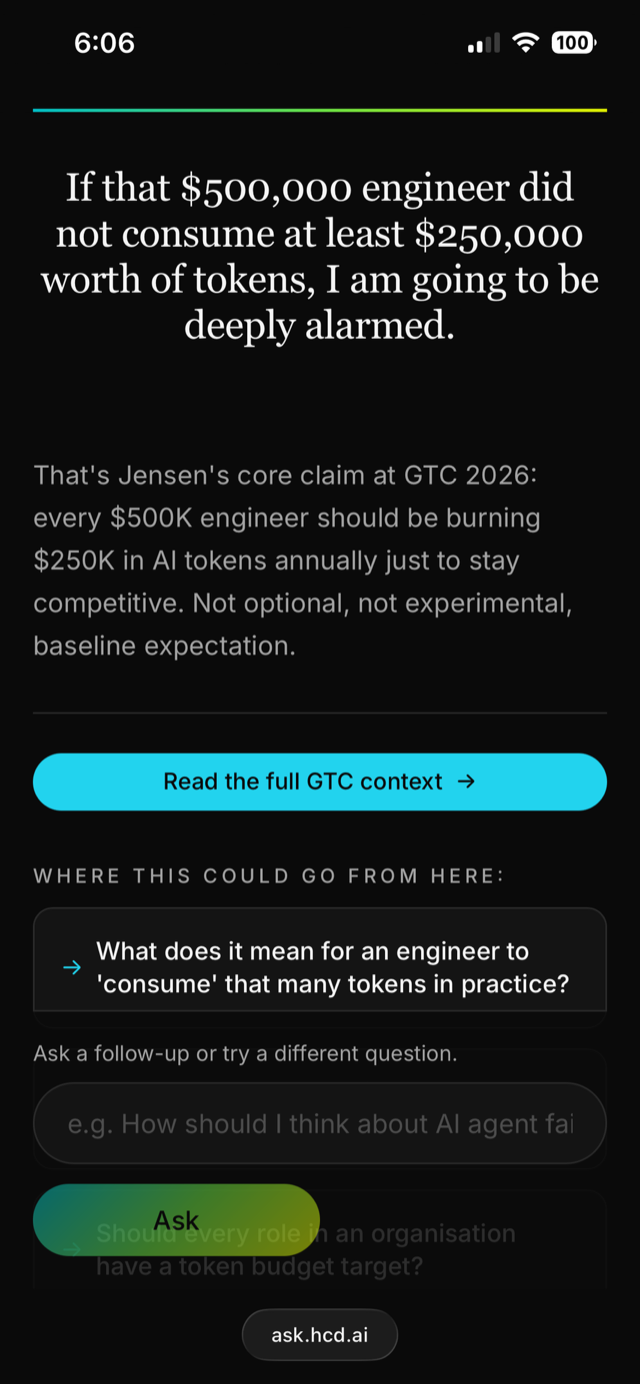
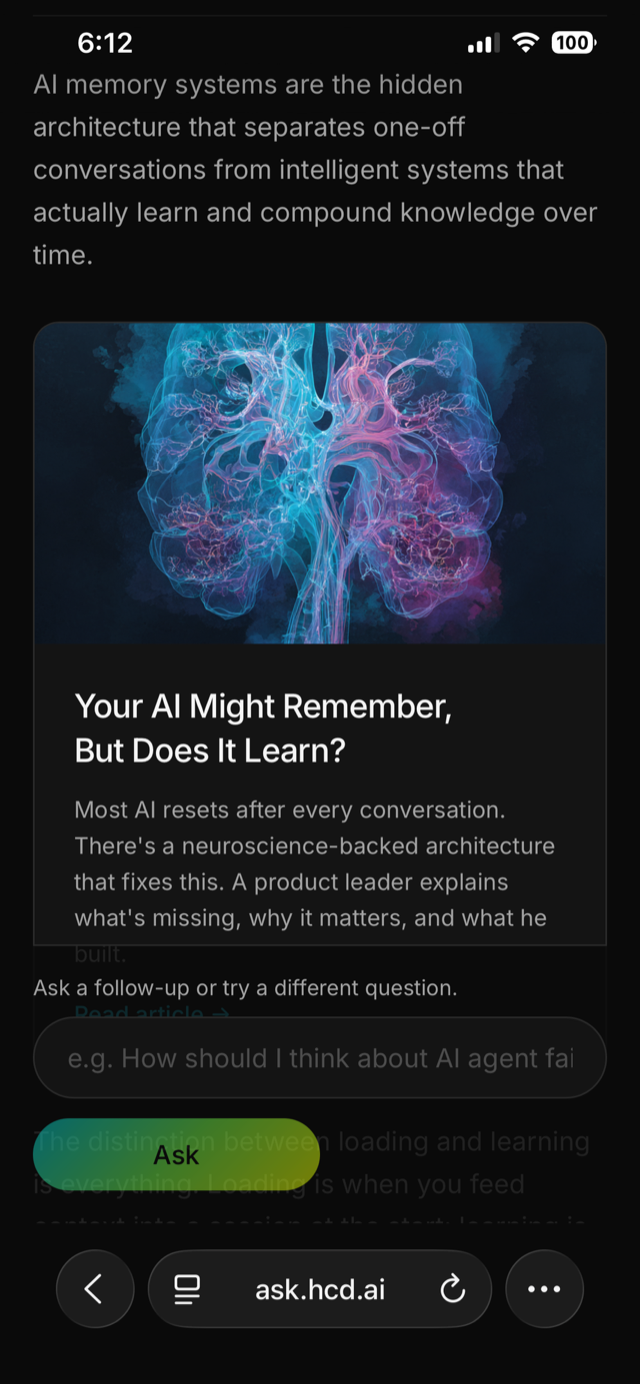
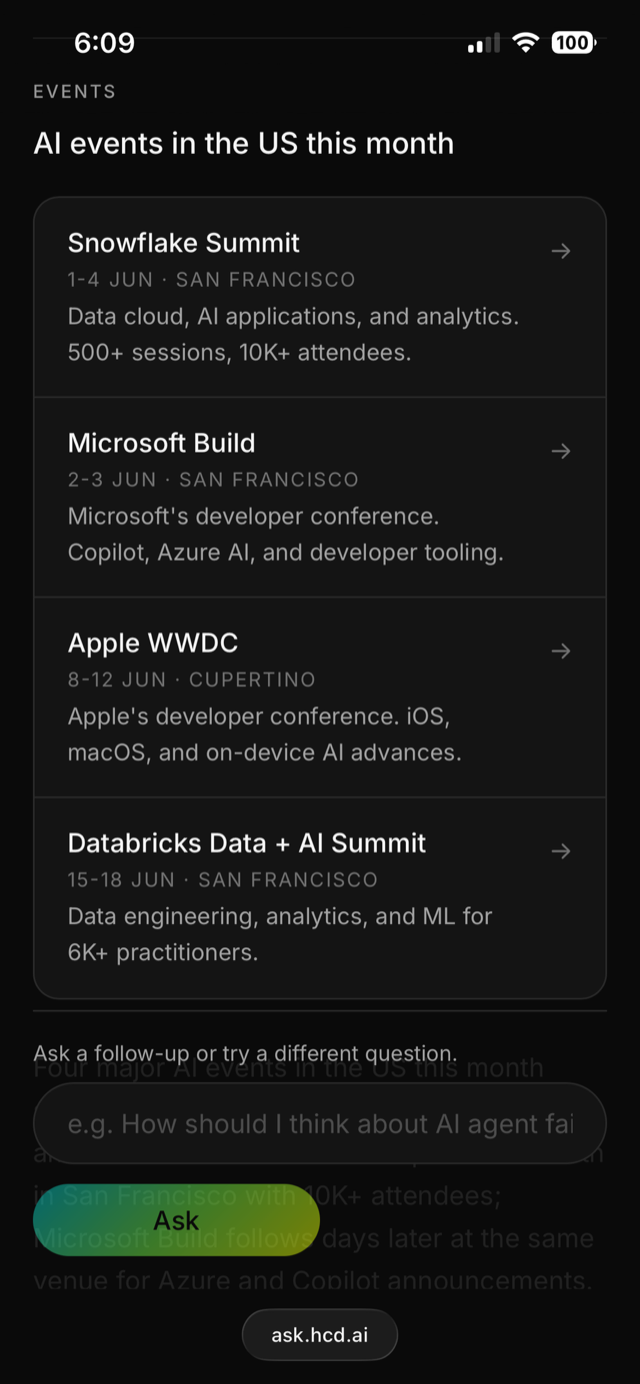
The unit of design moves up a level. It was the page or the screen. Now it is the system underneath the page. The work is no longer composing the answer. It is composing the space of possible answers, and the constraints that keep every one of them on-brand and correct. That is a different deliverable, and it asks a different question. Not "what should this page say?" but "what is this agent allowed to say, and how should they say it?"
The tooling has already started moving this way, a signal that the shift is real and that this is not just some thought experiment. OpenAI launched Apps in ChatGPT in October 2025, surfacing interactive interfaces from partners like Spotify and Canva inside the chat window. Google launched generative UI with Gemini 3 in November 2025, generating a custom interface on the fly for a single prompt. Both are the infrastructure for agents composing interfaces at runtime. What is still rare is a brand owning that composition on its own domain.
For years product design has been guided by the DVF model: what's desirable for people, viable for the business, and feasible with technology, the three overlapping lenses IDEO placed at the heart of human-centred design. The job was to find the overlap and design for it. I believe agents will increasingly become the orchestration engine of those overlapping areas, holding the three together at runtime for every visitor.
Why now
Several forces have already been in play and driving towards GenUI as a possible solution. Included amongst these:
Websites are crumbling under the weight of legacy. Most traditional websites are a growing maintenance burden. The bigger the site, the heavier that upkeep, and most of it is still manual. An orchestrated experience changes the shape of the problem. There are no templates to migrate, no navigation tree to re-architect, no page designs to refresh, so the work becomes maintaining good content rather than rebuilding the scaffolding around it.
1:1 experiences are now cheap. Personalisation used to mean a segmentation matrix, a rules engine, and a quarter of engineering to ship four variants of a landing page. An agent composes a genuinely individual response per visitor for a few cents a question. The economics of one-to-one flipped from enterprise-budget to portfolio-side-project, which is the precondition for it to become increasingly common.
Dynamic beats legacy on cost and go-to-market. A static site encodes every decision at build time and ships the same artefact to everyone. An orchestrated experience decides at request time. The content set updates, and every future answer updates with it, with no rebuild and no redeploy of the experience layer. The marginal cost of a new "page" drops to zero because there are no pages to make anymore.
Mobile primitives killed desktop creative. The desktop era rewarded creative layout: full-bleed heroes, asymmetric grids, bespoke layouts to help differentiate brands. Mobile flattens this. On a phone, the design surface is a vertical stack of UI primitives, e.g., a card, a list, a quote block, an input. Once the experience is translated into a stack of primitives, having an agent assemble that stack per visitor is a small step, not a leap.
Chat became an interface, not a feature. A growing number of people now treat a text box as the front door to anything, asking rather than browsing to find. Chat is no longer a support widget in the corner. For many, it has become the default way in, and a brand that only offers a navigation tree is asking those people to work in a mode they have started to leave behind.
How to do it
A GenUI surface reconciles three things: what the business needs (e.g., sell the product), what the customer needs (e.g., find, evaluate, and buy the product), and the means that connects the two. Design has always sat at that intersection. What changes is the meeting point on the page is not hand-drawn. The system is set up, and an agent composes the experience, personalised for each visitor.
I see this space evolving from these four layers:
| Layer | What it does | In practice |
|---|---|---|
| Ingredients | The raw material the agent assembles | Content, media, code |
| Instructions | The goals it serves, and the rules that reconcile them | Business needs, customer needs, the constraint set |
| Equipment | The technology it runs on | The model, tokens and cost, the agent loop, hosting |
| Verification | What keeps every answer true and on-brand | The validator, verbatim citation matching |
The first three layers generate the personalised experience. The fourth is what makes it safe to ship. Verification is where a validator checks every quoted line against the source before it renders, the same verification discipline that separates a clever demo from something a brand can put its name on.
For an executive, that is where the effort moves: less into design cycles and redesigns, more into the quality of the content and the clarity of the instructions. Get those two right and the surface largely runs itself.
Case study: ask.hcd.ai
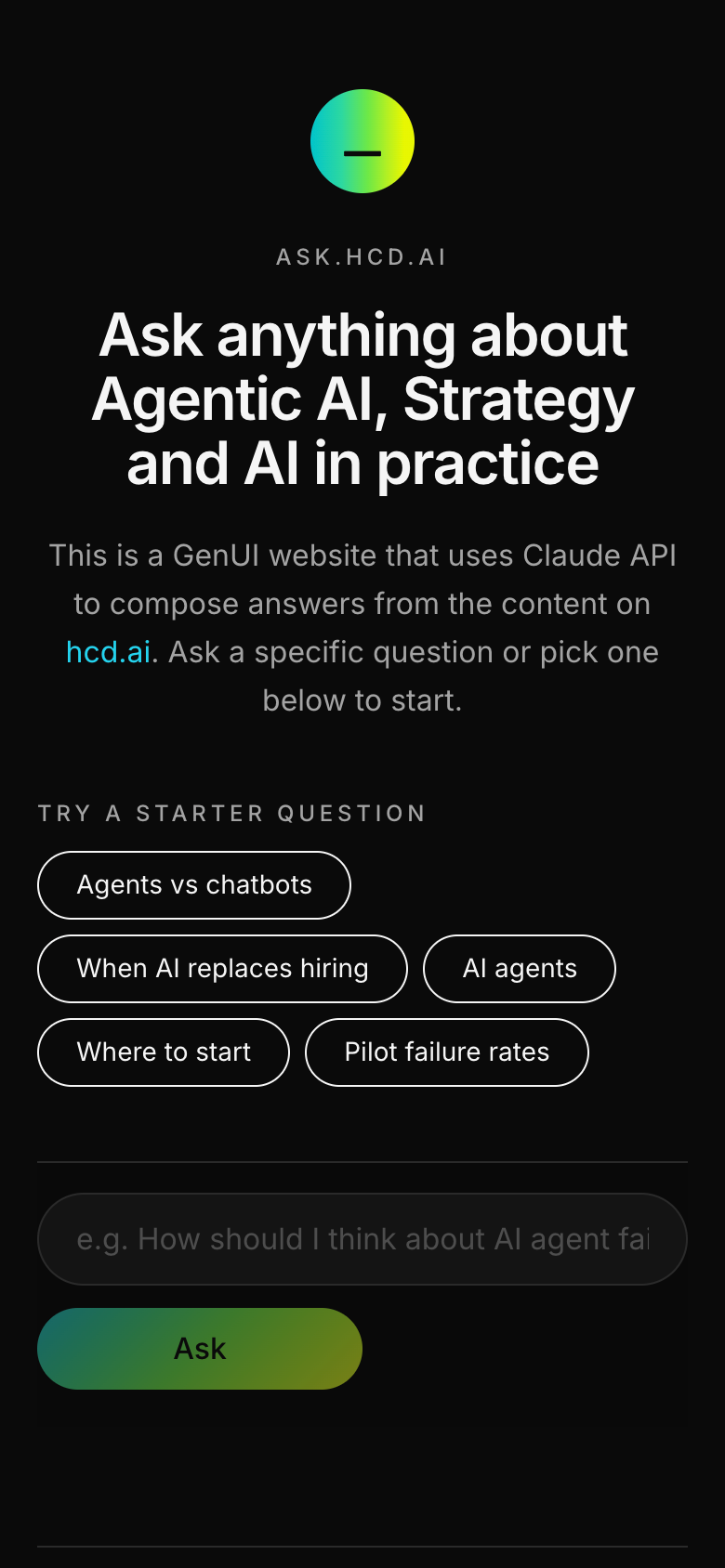
ask.hcd.ai is a working example of a GenUI website and one I created to explore and begin to understand this space. It is the GenUI version of hcd.ai.
A visitor asks a question, and the page composes a personalised answer from a fixed pool of components filled with verbatim content from hcd.ai articles, and, for cross-vendor questions, from Anthropic, OpenAI, and Gemini documentation.
The interaction is the visible break from chat. Each question and answer appends as a new segment below the last, the input is sticky-bottom, and two or three suggested follow-ups appear as cards at the end of each answer. It reads like a stitched-together article, not a conversation with a bot.
Here is a breakdown of how everything comes together:
| Spec | ask.hcd.ai |
|---|---|
| Stack | Astro, Tailwind and React 19 islands on the front end, PHP on Siteground on the back end, answers streamed to the browser over Server-Sent Events |
| Model | Claude Haiku 4.5 at roughly $0.04 a question, up to about $0.50 across a multi-question session. Cost is dominated by cache reads across the multi-turn loop |
| Prompt | around 31K tokens after a lexical retrieval step: a compact catalogue of every article and glossary term plus the full text of only the roughly six articles retrieved for the question, with voice rules |
| Caching | the stable catalogue and rules are cached with Anthropic prompt caching at a five-minute TTL, so repeat requests pay a fraction. This replaced an earlier 100K-token prompt that inlined the whole library |
| Components | 13 typed React components, including a video_card for inline-playable video, plus a suggest_followups meta-tool, emitting structured tool calls so off-brand output is impossible |
| Composition | a multi-turn tool loop, up to five turns under wall-clock and token budgets, placing three to five components per answer |
| Routing | a regex detects the opening question shape and forces tool_choice on turn zero, then switches to auto, so a definitional question and a comparison render visibly differently |
| Validation | one server-side validator per component, checking a verbatim citation match against the source paragraph, a slug-in-index lookup, and a URL allowlist, with failures logged and dropped rather than shown |
| Content | around 26 hcd.ai articles indexed with SHA-256 paragraph IDs, plus Anthropic, OpenAI and Gemini docs pulled through an allowlisted web fetch for cross-vendor questions |
| Performance | first component visible in one to two seconds via streaming, a full multi-turn answer in roughly eight to twenty seconds, hosting incremental-zero on the existing plan |
The validator is the part that earns trust. Venkit et al. (2025) and Columbia Journalism Review both found AI search misattributing or fabricating citations in more than half the responses they tested, and on a brand's own domain that is unacceptable. Nothing renders until it has been checked against the source.
Where to next
ask.hcd.ai is an initial stepping stone. For a first release it's 'Ok', but inevitably the process surfaced strategic questions and a whole list of features I'm keen to explore.
Performance. The ultimate test is whether any of this delivers for the business and the customer. A GenUI surface is only worth building if it converts better, serves people faster, or moves a number the business already cares about. Given the costs involved I would move to an open source LLM or high value sales funnel use. This will be the next step in my journey.
What skills are required. The team that builds this will not look like the team that built websites. The deliverable is a content-and-rules system rather than a set of screens, so the centre of gravity shifts toward people who can shape content as something a machine consumes. Content engineering will become a key role, and beyond that the multi-skilled person who can take a surface end-to-end, from content to components to constraints.
Personalisation. When every visitor can be given a genuinely individual experience, the creative space opens up in a way a fixed page, or even a more dynamic one, never allowed. The shift I find most interesting is where the effort might go: less of it on the indirect work of building and maintaining the scaffolding, and more on the content and decisions that drive real customer value.
AI search. The content that feeds a GenUI surface is the same content AI search engines reach for, which turns the source itself into a strategic asset. A brand could structure and even gate it deliberately for the bots that quote it, optimising for AEO and GEO at the source rather than page by page. Conventions like llms.txt already point this way: a curated, machine-readable file a site publishes so agents read the version it intends rather than scraping the rendered pages.
Traditional search. Googlebot ranks stable, crawlable pages, and a surface that renders different content for every visitor sits close enough to cloaking to be worth taking seriously. The workable answer is to keep a canonical static site as the indexable surface and treat the GenUI layer as a query-shaped interface over the same content, though how cleanly that line holds up I don't believe is known.
Frequently Asked Questions
What does it mean to design for agents that orchestrate experiences?
The unit of design moves up a level. Instead of drawing the page a visitor sees, the brand assembles the system an agent draws from at runtime: the content, the components it can place, the objectives it serves, and the rules it cannot break. The agent then composes a 1:1 experience for each visitor from that system. The deliverable changes from screens and flows to a content-and-rules system.
How is this different from a chatbot or from ChatGPT?
Chat surfaces like ChatGPT, Claude, or Perplexity are vendor-hosted, so the answer lives on the vendor's domain. A GenUI surface lives on the brand's own domain, over the brand's own content, with its voice rules and citation discipline applied at runtime. It reads differently too: a sticky-bottom input, segments appended below the last answer, and suggested follow-up cards make it a journey through the brand's content rather than a threaded conversation.
What does it cost to run?
Hosting is incremental zero on an existing LAMP host. On Anthropic credits, Claude Haiku 4.5 runs roughly $0.04 a question with prompt caching active, or up to about $0.50 across a multi-question session. Sonnet 4.6 costs a few times more for tighter instruction-following. Most of the spend is cache reads across the multi-turn loop, not fresh input. These costs can quickly add up so an open source LLM is recommended or use in high value sales funnels.
What skills does it take to build a GenUI website?
Not the same mix that built traditional websites. The deliverable is a content-and-rules system rather than a set of screens, so the work leans on people who can shape content as something a machine consumes and write the rules that keep an agent on-brand. Content engineering will become a key role, alongside someone multi-skilled enough to take a surface end-to-end, from content to components to constraints.
Does Google penalise an agent-composed surface?
A GenUI surface renders different content for every visitor and has no fixed page to crawl, which sits awkwardly against a ranking system built on stable, indexable pages and raises the question of whether Google reads it as cloaking. The pragmatic move is to keep the canonical static site as the indexable surface Google reads and treat the GenUI layer as a query-shaped interface over the same content, not a replacement for it.
What's the risk that the model fabricates a citation?
Real and recurring: the initial model paraphrased verbatim text, invented plausible-but-fake events, and occasionally created fake URLs. Verbatim validation server-side catches all three, with rejected components logged and dropped rather than shown. Columbia Journalism Review tested eight AI search engines and found more than half of responses carried incorrect attributions, some fabricating citations or inventing URLs outright. On a brand-owned surface the validator is the brand-integrity layer, and without it one hallucinated quote ends the demo.
Screenshot from ask.hcd.ai